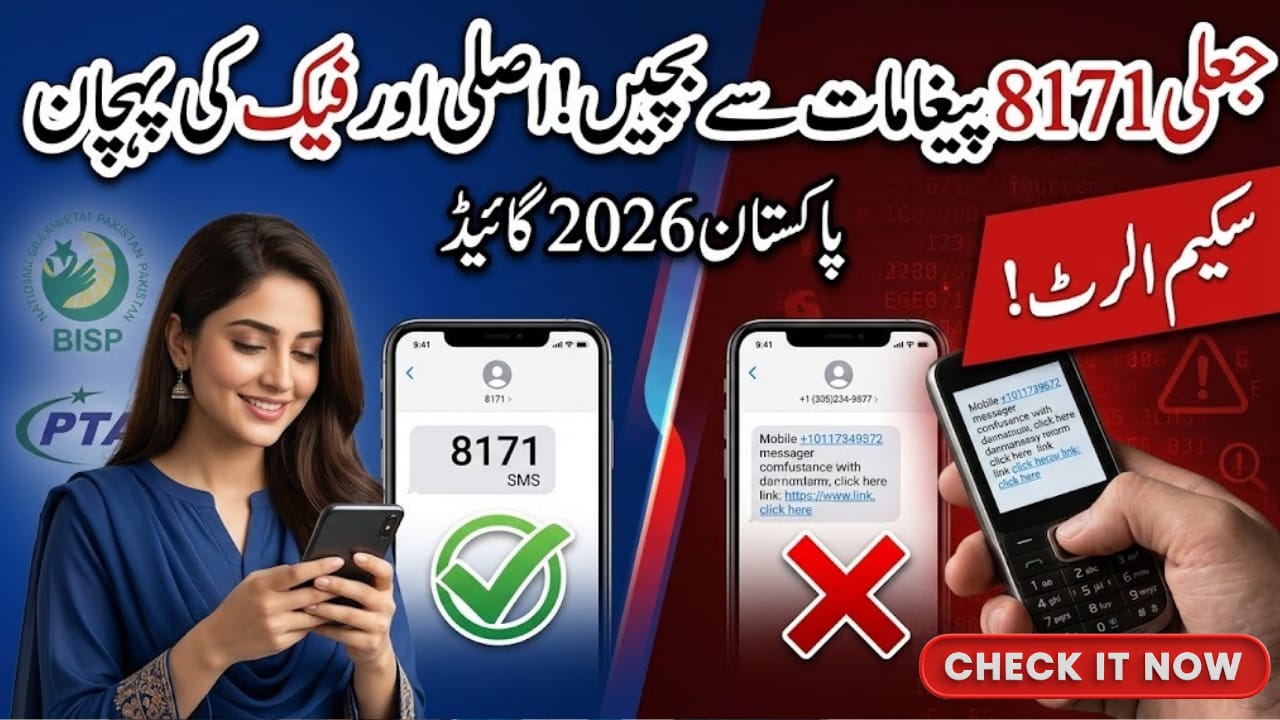

Fake 8171 Messages
In 2026, the Benazir Income Support Programme (BISP) continues to provide financial support to millions of families in Pakistan. However, as the program grows, scammers are also becoming more active. Many citizens now receive fake 8171 messages pretending to be official government notifications. These fraudulent SMS alerts are designed to steal personal information, CNIC numbers, or even money through mobile wallets. Understanding how to recognize a real BISP message is now essential to keep your payments and personal data safe.

Table of Contents
Read Also: Sindh Announces Spring Holidays
| Feature | Real 8171 BISP Message |
| Sender ID | Always sent from 8171 |
| Language | Clear Urdu or simple English |
| Purpose | Payment updates or eligibility status |
| Personal Data | Does not ask for PIN or OTP |
| Fees | Never requests money |
| Links | Only official government portals |
| Instructions | Visit ATM or BISP center |
| Security | Verified through government systems |
What Are Fake 8171 Messages?
Fake 8171 messages are scam SMS alerts sent by criminals pretending to represent BISP or Ehsaas programs. Their goal is to trick beneficiaries into sharing sensitive information or sending money through mobile payment services.
These messages often appear convincing because they use official names like “BISP Head Office” or “8171 Director.” However, they usually come from normal mobile numbers rather than the official shortcode.
Information in this article is based on the official BISP portal and insights gathered from the official website and top Google sources that report on BISP updates and cyber scams.
The Golden Rule: Only Trust the 8171 Shortcode
The most important rule for BISP beneficiaries is simple: the government communicates only through 8171.
- Official sender: Genuine messages always appear from the shortcode 8171.
- No private numbers: If the SMS comes from a number starting with 03, it is fake.
- No confidential requests: BISP never asks for your ATM PIN or OTP.
- No payment demand: Government programs do not charge fees for registration or payments.
Following this rule can help you avoid most common scams.

Common 8171 Scams in Pakistan (2026)
Scammers frequently use similar tactics to target beneficiaries.
1. Payment blocked message: Fraudsters claim your BISP payment is suspended and ask you to call a mobile number to reactivate it.
2. Prize reward scam: Some SMS messages promise a reward of Rs. 25,000 or more but ask for a small tax or transfer fee.
3. Fake verification request: Scammers ask for your CNIC number and other details to confirm eligibility.
4. WhatsApp assistance: Messages redirect users to WhatsApp numbers pretending to be BISP support.
In reality, BISP payments are fixed and do not involve prize draws or special bonuses.
How to Verify Your BISP Status Safely
You can easily check your eligibility using the official process.
- Open the SMS application on your phone.
- Type your CNIC number without dashes.
- Send the message to 8171.
- Wait for the automated reply with your eligibility status.
- You can also check through the official website: https://8171.bisp.gov.pk
Using these official channels ensures your data stays safe.
Warning Signs of a Fake 8171 Message
There are several clear indicators that an SMS is fraudulent.
1. Unknown sender: The message comes from a random mobile number.
2. Grammar mistakes: Scam messages often contain spelling or formatting errors.
3. Suspicious links: Links lead to unknown domains or shortened URLs.
4. Money requests: The sender asks for EasyPaisa or JazzCash transfers.
If you notice any of these signs, treat the message as a scam.
What To Do If You Receive a Scam SMS
If you suspect a fake message, take the following precautions.
1. Do not reply: Responding confirms your number is active.
2. Avoid calling the number: Scammers may attempt further fraud.
3. Do not click links: These may install malware on your phone.
4. Report the message: Inform the relevant authorities.
Quick reporting helps authorities track and block scam networks.
Helpline & Contact
If you need help or want to verify information, contact official authorities.
- BISP Helpline: 0800-26477
- PTA Scam Reporting: Forward suspicious SMS to 7727
- FIA Cyber Crime Wing: Call 1991
- BISP Office: Visit the nearest Tehsil BISP center for assistance
These official channels can confirm whether a message is genuine.
Conclusion
Fake 8171 messages have become a serious problem in Pakistan as scammers try to exploit welfare programs. The safest approach is to trust only messages sent from the 8171 shortcode and verify your status through official channels. Never share sensitive information or send money based on an SMS. By staying alert and reporting suspicious messages, citizens can protect themselves and ensure that government support reaches the people who truly need it.
FAQ
What is the official number used by BISP for SMS?
The official number used by BISP for SMS communication is 8171.
Can BISP ask for money to release payments?
No. BISP never charges registration fees or payment processing charges.
How can I check my BISP eligibility?
You can send your CNIC number to 8171 or check your status on the official BISP portal.
Where can I report fake 8171 messages?
You can forward the message to 7727 (PTA) or contact the FIA Cyber Crime Wing at 1991.
Latest Updates
 Breaking: 8171 Fresh March Update 2026 – Check Rs.13,500 Payment via BISP Portal
 Breaking: BISP 8171 Eid Payment 14500 Start Today – Check Online & Latest Update 2026
 Breaking News: Petrol Diesel Prices in Pakistan May Rise Before Next Update – New Petrol Price Forecast 2026
 Breaking: NADRA CNIC Smart Card Check New Features March 2026 – Complete Step-by-Step Guide
 Breaking News: Livestock Card Third Installment 2026 Released – Check Eligibility & Payment Method Now
 Breaking: BOP Announced ATM Cardfor BISP 2026 Payment (Step-by-Step Guide)